
How fat loss works
Your body uses energy even when you’re lying still – for breathing, your heart, your brain and body temperature. This is your basal metabolic rate (BMR), and for most people it makes up 60 to 70% of the whole day. Add walking, training and digesting food, and you get your daily energy expenditure.
When you eat less than you burn over time, your body takes the missing energy from its stores. That’s a calorie deficit – the only way to lose body fat. No food “burns fat” and no diet gets around it. Diets only differ in how easy they make the deficit to stick to.
Calorie and protein calculator
Enter your details or your client’s. The calculator works out BMR, daily expenditure, calories for the goal and protein.
An estimate for healthy adults. Not suitable during pregnancy or breastfeeding, for children or with eating disorders – then a doctor or registered dietitian should set the plan.
BMR: Mifflin-St Jeor (1990) – the most accurate of the commonly used equations in a comparative review (Frankenfield et al. 2005). Daily expenditure: standard activity factors 1.2 – 1.9. Protein: 1.6 – 2.2 g/kg for fat loss and muscle gain, 1.4 – 2.0 g/kg for maintenance (ISSN, Jäger et al. 2017; Morton et al. 2018), based on goal weight when overweight. Fat 30% of energy (recommended range 20 – 35%). Pace: 7,700 kcal ≈ 1 kg (3,500 kcal ≈ 1 lb), a rough estimate.
How big a deficit to choose
More isn’t better. Too big a deficit makes you hungrier, drains energy for training and costs muscle too. For most people this works:
- 10 to 20% below daily expenditure – fat loss you can keep up for months, not weeks.
- 0.5 to 1% of body weight a week – at 80 kg that’s 0.4 to 0.8 kg. Faster often comes at the expense of muscle.
- Not below BMR – if the numbers come out lower, add movement instead.
Weight can swing by 1 to 2 kg from day to day – water, salt, the menstrual cycle, digestion. Track the weekly average, not a single morning. If the average stalls for 2 to 3 weeks, cut 100 to 200 kcal or add steps.
Why protein matters so much
If you track only one thing besides calories while losing fat, make it protein.
- It protects muscle. In a deficit the body also takes energy from muscle. Enough protein plus strength training helps make sure you lose mostly fat.
- It keeps you full. After a protein-rich meal you stay full for longer, so the deficit is easier to stick to.
- Your body burns more digesting it. Digesting protein uses 20 to 30% of its energy. For carbs it’s 5 to 10%, for fat 3% at most.
- Recovery. Muscles repair and grow after training from protein.
How much? The recommended 0.8 g per kilogram is the minimum for inactive people. If you train and want to lose fat, you need more – 1.6 to 2.2 g per kilogram of body weight a day. At 70 kg that’s 110 to 155 g. With a lot of weight to lose, use your goal weight – the calculator does this for you.
How to get enough protein
- Protein at every meal. 3 to 4 meals of 25 to 40 g are far easier than catching up in the evening.
- Start with breakfast. Eggs, skyr, quark or Greek yogurt instead of just toast.
- Protein goes on the plate first. Pick meat, fish, legumes or tofu – then the sides.
- Snacks with protein. Skyr, cottage cheese or a bowl of edamame instead of biscuits.
- Cook for several days. Roasted chicken or cooked lentils in the fridge save decisions.
- Plant-based? Combine legumes, tofu, tempeh and grains through the day – together they provide all essential amino acids.
- Protein powder is a supplement, not the base. Handy when you’re short on time. Real food also brings fibre and vitamins.
Watch out for “protein” bars and cookies – they often contain more sugar and fat than protein. A simple rule helps: how many grams of protein per 100 kcal. You’ll see it for every food in the library below.
Food library
- Pick a nutrientTap protein, carbs or fat. You’ll see the foods with the most of it.
- Add what you eat todayTap + next to a food. One tap is one portion.
- See what’s missingEach nutrient shows how much you have and how much is left to the calculator target.
Your day is saved only on this phone or computer – nothing is sent anywhere. Each morning you start a new day with an empty list.
Values: USDA FoodData Central and typical labels, rounded. Carbs exclude fibre, as on EU labels. They vary by product and preparation.
Eating guide: the plate and the whole day
You don’t need to weigh every bite. For most meals a simple plate rule is enough:
- Half the plate vegetables – raw or cooked. Volume and fibre fill you up for few calories.
- A quarter protein – a palm-sized portion: meat, fish, eggs, quark, tofu or legumes.
- A quarter starch – potatoes, rice, wholegrain pasta or bread. Less when losing fat, more on training days.
- A little fat – a spoon of oil, some avocado or a few nuts. Your body needs fat, it’s just calorie-dense.
- Water or an unsweetened drink – calories from drinks don’t fill you up.
Two sample days – about 1,800 kcal and 130 g protein. One with a savoury breakfast, one with protein porridge. Alternate them and swap meals to your taste.
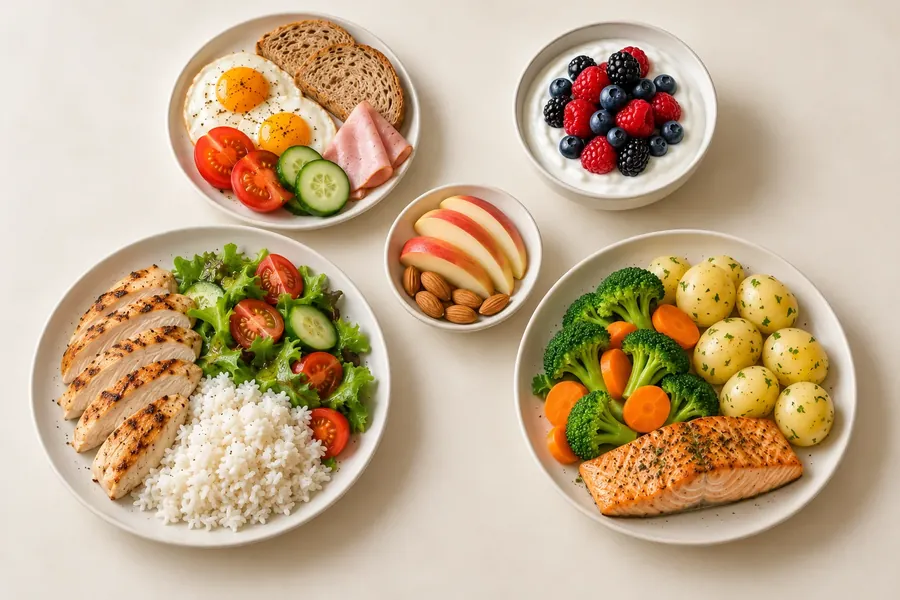
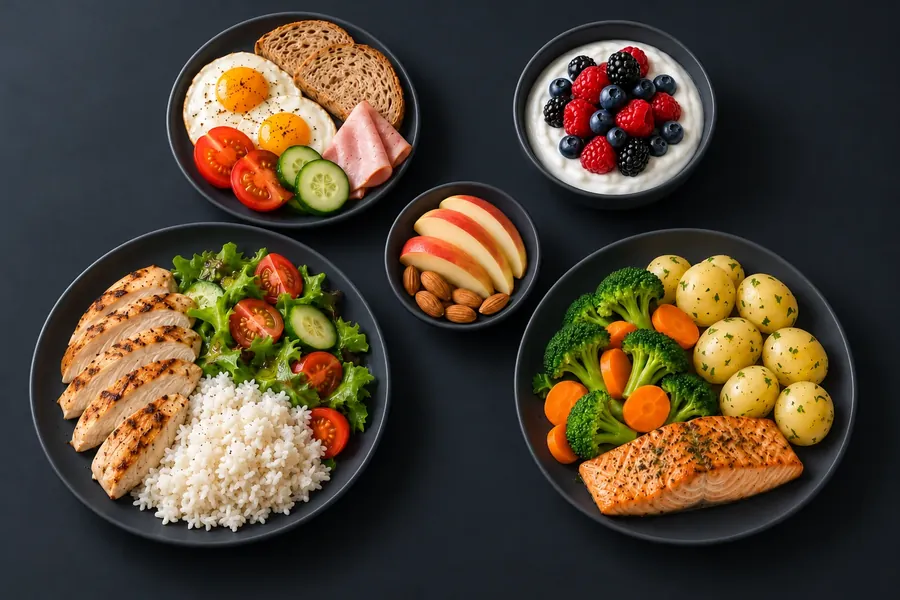
- Breakfast2 eggs, 30 g ham, 70 g wholegrain bread, tomato and cucumber385 kcal
- Mid-morning200 g skyr, 100 g mixed berries170 kcal
- Lunch150 g chicken breast, 70 g rice, salad with a tablespoon of olive oil525 kcal
- Afternoonan apple, 20 g almonds195 kcal
- Dinner120 g salmon, 250 g potatoes, 200 g vegetables495 kcal
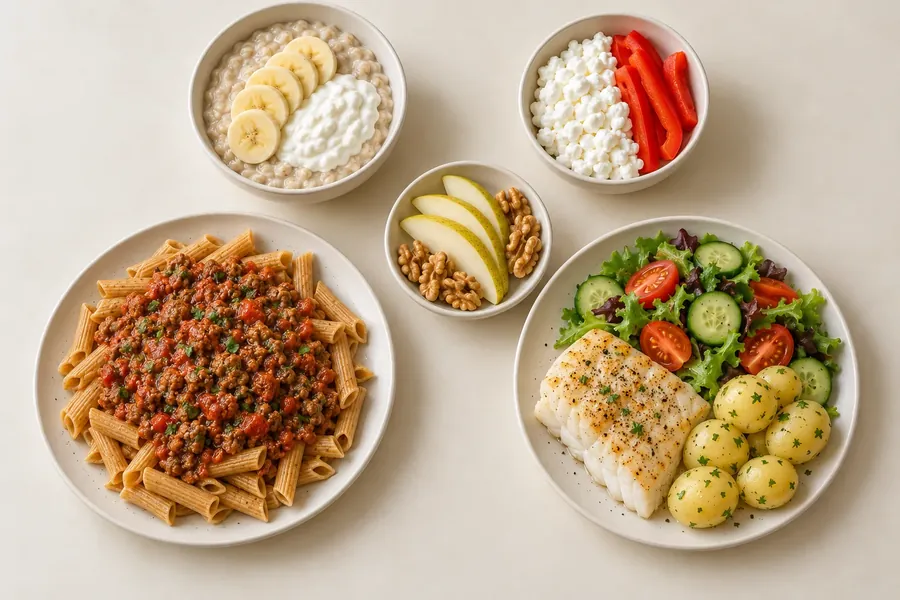
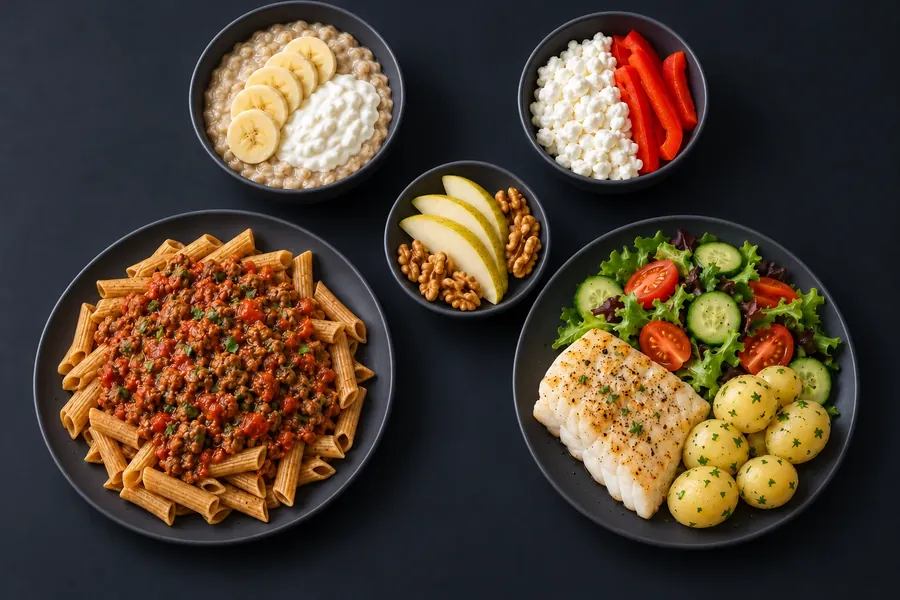
- Breakfastprotein porridge: 60 g oats, 200 ml milk, 125 g quark, a banana500 kcal
- Mid-morning150 g cottage cheese, bell pepper175 kcal
- Lunch130 g lean beef, 70 g wholegrain pasta, tomato sauce530 kcal
- Afternoona pear, 15 g walnuts185 kcal
- Dinner180 g cod, 200 g potatoes, salad375 kcal
Illustrations only, calories are approximate. Meat, fish, rice and pasta are weighed raw.
Healthy habits that last
- Regular meals – 3 to 4 meals a day, no starving all day and overeating at night.
- Fruit and vegetables every day – at least 400 g, ideally with every meal.
- Stay hydrated – drink throughout the day, more when training and in the heat.
- 7 to 9 hours of sleep – after a bad night you’re hungrier and crave sweets more.
- Steps – 7,000 to 10,000 a day burn more than you think and make the deficit easier.
- Strength training 2 to 3× a week – so you lose fat, not muscle.
- Alcohol in moderation – it’s high in calories and hurts sleep and recovery.
- The 80/20 rule – eat sensibly most of the time and enjoy the rest without guilt. One slice of cake won’t ruin anything.

Frequently asked questions
How accurate is the calculator?
It uses the Mifflin-St Jeor equation – in an expert comparison of the four most widely used equations it came out as the most accurate, and well-known food tracking apps use it too. For an individual, though, the result can be off by 10% or so. Treat the result as a starting point: stick to it for 2 to 3 weeks, watch your average weight and adjust.
Why does fat loss slow down over time?
A lighter body burns less energy, and during a long deficit people unconsciously move less. Recalculate with your new weight and keep an eye on steps. Some people also benefit from a week or two at maintenance calories.
Do I have to count calories?
Not necessarily. Two weeks of tracking at the start help – you’ll see how much you really eat. After that, the plate rule and enough protein are enough for most people.
Is a lot of protein harmful?
For healthy people, 1.6 to 2.2 g per kilogram has not been shown to cause harm. With kidney disease, a doctor should set the protein intake.
Do I need a protein shake right after training?
What matters most is the total for the day. Spreading it over 3 to 4 meals helps, but there’s no need to rush for a shake straight after training.